When seconds count during a cardiac emergency involving an infant, knowing the exact placement of AED pads can save a life. Automated external defibrillators are powerful tools designed to restore a normal heart rhythm. However, using them on infants requires special knowledge and techniques.
This guide provides clear, evidence-based information on AED pad placement for infants. You’ll learn when to use an AED, proper positioning techniques, and critical safety considerations.
What is an AED?
An automated external defibrillator (AED) is a portable electronic device. It analyzes heart rhythm and delivers electric shocks when needed. The device restores normal rhythm during sudden cardiac arrest.
AEDs are designed for use by both trained professionals and laypersons. The device provides voice prompts, visual cues, and text instructions. This makes it accessible even during high-stress situations.
According to the American Heart Association, AEDs detect shockable rhythms with high accuracy. They recommend delivery of a shock only when appropriate. This safety feature prevents unnecessary shocks to patients with non-shockable rhythms.
Can an AED Be Used on Infants?
Yes, AEDs can and should be used on infants experiencing cardiac arrest. An infant is defined as a child under one year of age. The American Red Cross Scientific Advisory Council confirms that AEDs should be used when a manual defibrillator is not immediately available.
Pediatric AED Pads for Infants
Pediatric AED pads deliver reduced energy levels. These pads are designed for children weighing less than 55 pounds. The energy output is typically around 50 joules, compared to adult pads that deliver 150-360 joules.
If pediatric pads are unavailable, adult pads can be used. The key is proper placement to prevent the pads from touching each other. Using adult pads is better than not using an AED at all.
Research shows that AED algorithms have high sensitivity for pediatric arrhythmias. Studies demonstrate successful use of AEDs in infants with appropriate energy attenuation.
When to Use an AED on Infants
Use an AED on an infant when you observe these critical signs:
The infant is unresponsive. Gently flick the feet or tap the shoulder. No response indicates potential cardiac arrest.
The infant is not breathing normally. Watch for chest rise and fall. Listen for breath sounds. Agonal breathing (gasping or irregular breaths) is not normal breathing.
No pulse is detected. For infants, check the brachial pulse on the inner arm between the shoulder and elbow.
Cardiac Arrest in Infants: Understanding the Emergency
Sudden cardiac arrest in infants is rare but serious. According to the Children’s Hospital of Philadelphia, SCA accounts for 10-15 percent of sudden unexpected infant deaths.
Common causes include:
- Congenital heart defects present from birth.
- Respiratory failure leading to cardiac complications.
- Severe infections such as sepsis or meningitis.
- Sudden infant death syndrome (SIDS).
The American Heart Association emphasizes immediate action. When an infant collapses, every second counts. CPR combined with AED use within the first few minutes increases survival chances by 75 percent.
Where is the Correct AED Placement for an Infant?
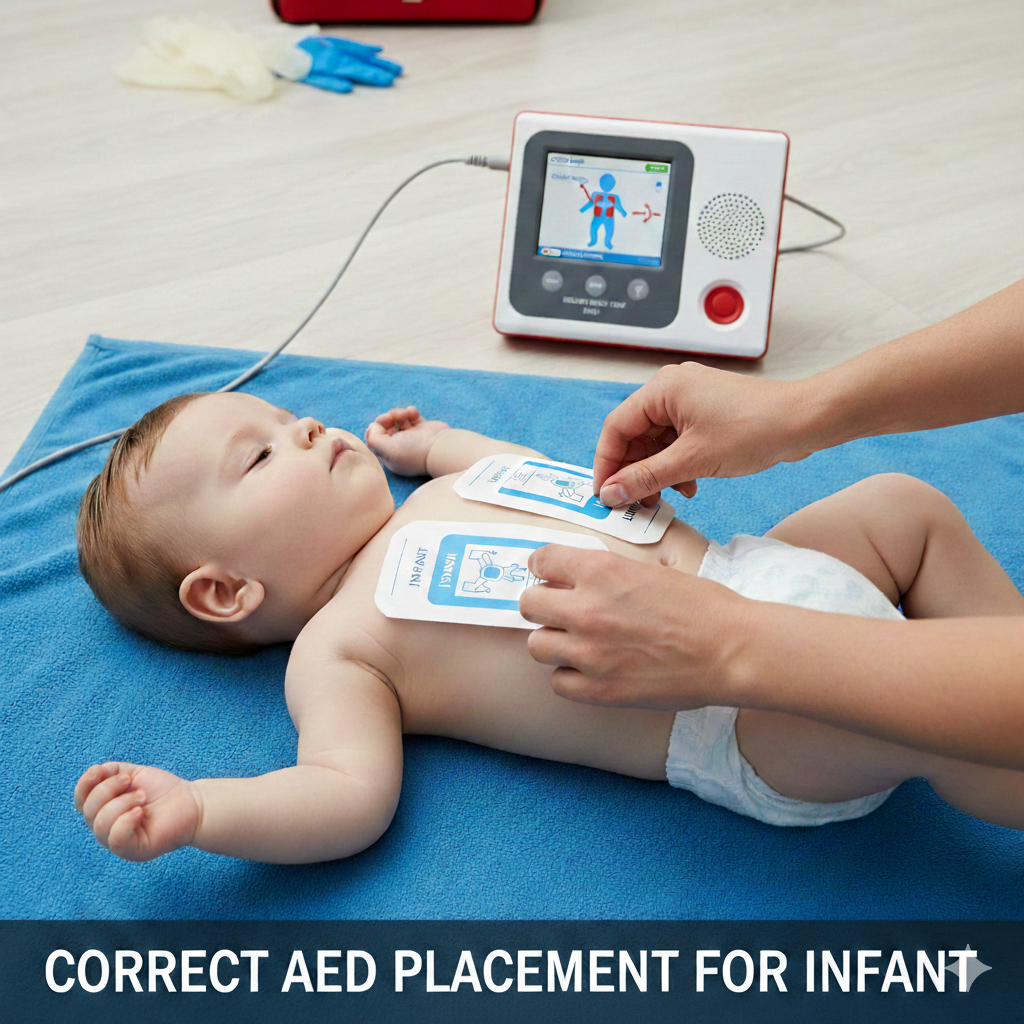
Proper AED pad placement on infants differs from adults. The anterior-posterior position is the recommended method for infant AED pads.
Step-by-Step AED Pad Placement on Infants
Step 1: Expose the chest. Remove all clothing from the infant’s chest and back. Ensure the skin is dry. Moisture can reduce pad adhesion and effectiveness.
Step 2: Turn on the AED. Follow the voice prompts immediately. The device will guide you through each step.
Step 3: Prepare the pads. Peel the backing from the pediatric pads. If using adult pads, prepare both simultaneously.
Step 4: Place the first pad. Position one pad on the center of the infant’s chest. The pad should sit on the sternum (breastbone).
Step 5: Place the second pad. Position the second pad on the infant’s back. Place it between the shoulder blades along the spine.
Where Should Pads Be Placed on an Infant?
The anterior-posterior placement method ensures an optimal electrical pathway. This positioning is necessary because:
An infant’s chest is small. Two pads cannot fit side-by-side without touching. Touching pads creates electrical short circuits. This prevents effective shock delivery.
Front pad location: Center of the chest on the sternum. The pad should cover the area between the nipples.
Back pad location: Between the shoulder blades on the upper back. Position the pad along the spine at heart level.
This front-to-back configuration allows electrical current to travel through the heart effectively. The shock crosses the maximum amount of cardiac tissue.
Critical Safety Considerations for Infant AED Pads
Never delay treatment waiting for pediatric pads. Adult pads are acceptable when pediatric options are unavailable. Place them in the anterior-posterior position.
Ensure pads make full skin contact. Press firmly around all edges. Poor adhesion reduces shock effectiveness.
Keep everyone clear during shock delivery. Announce loudly before pressing the shock button. Physical contact during shock can cause injury.
Continue CPR between shocks. High-quality chest compressions maintain blood flow. For infants, use two fingers or the encircling thumbs technique. Compress at least one-third of the chest depth.
Evidence-Based Guidelines for AED Use on Infants
The American Heart Association updated its guidelines based on extensive research. Their recommendations state that AEDs with attenuated energy doses are preferred for infants.
Studies show AED algorithms accurately identify shockable rhythms in pediatric patients. The algorithms demonstrate high specificity, avoiding inappropriate shocks for non-shockable rhythms.
Research from the International Liaison Committee on Resuscitation supports early defibrillation. Data shows that survival rates decrease 7-10 percent for every minute without defibrillation.
According to recent AHA statistics, only 8.4 percent of pediatric patients with out-of-hospital cardiac arrest survive to discharge. Immediate CPR and AED use significantly improves these outcomes.
Important Reminders About AED Pads on Infants
Always call 911 first. Activate emergency medical services immediately. Then begin CPR and prepare the AED.
Manual defibrillators are preferred when available. Trained healthcare providers can adjust energy levels precisely. However, AEDs are excellent alternatives for lay rescuers.
Check pad expiration dates regularly. Expired pads may have reduced adhesive quality. Replace pads according to manufacturer guidelines, typically every 2-4 years.
Training makes a difference. Formal CPR and AED certification increases confidence. Practice with infant manikins helps develop muscle memory.
Get Certified and Save Lives
Knowing how to properly place AED pads on infants is crucial. But hands-on training takes your skills to the next level. CPR St. Louis offers comprehensive certification courses that prepare you for real emergencies.
Our American Heart Association training site provides:
BLS for Healthcare Providers certification with infant CPR techniques. PALS (Pediatric Advanced Life Support) Class in St. Louis for advanced pediatric emergency care. Hands-on practice with infant, child, and adult manikins. Stress-free learning environment with experienced instructors. Same-day certification cards upon completion.
Whether you’re a healthcare provider, teacher, parent, or caregiver, proper training empowers you to act confidently. Our PALS Class in St. Louis covers advanced techniques for managing pediatric emergencies.
Don’t wait for an emergency to learn these critical skills. Register today for an AHA CPR course in St. Louis. Visit CPR St. Louis to find class schedules and locations near you. All our classes are hands-on, ensuring you gain practical experience with proper AED pad placement on infants.
Frequently Asked Questions About AED Pads on Infants
1. Can I use adult AED pads on an infant if pediatric pads are not available?
Yes, you should use adult AED pads if pediatric pads are unavailable. Place one pad on the infant’s chest center and one on the back between the shoulder blades. Ensure the pads do not touch each other. Never delay treatment waiting for pediatric equipment. Using adult pads with proper placement is far better than not using an AED at all. The American Heart Association confirms this approach saves lives.
2. What is the difference between anterior-lateral and anterior-posterior AED pad placement?
Anterior-lateral placement positions both pads on the front and side of the chest. This method works for adults and larger children. Anterior-posterior placement positions one pad on the front (chest) and one on the back. This method is required for infants because their small chest size cannot accommodate side-by-side pads. The front-to-back positioning prevents pads from touching while ensuring effective current delivery through the heart.
3. How do I know if an infant needs AED treatment versus just CPR?
If an infant is unresponsive, not breathing normally, and has no pulse, begin CPR immediately and use an AED as soon as available. The AED will analyze the heart rhythm and determine if a shock is needed. Not all cardiac arrests require shocks. Some rhythms respond only to CPR and medications. The AED’s sophisticated algorithm identifies shockable rhythms like ventricular fibrillation. Trust the device’s analysis. If it says no shock is advised, continue CPR and wait for emergency medical services.
Conclusion
Understanding proper AED pad placement on infants can mean the difference between life and death. The anterior-posterior method ensures effective shock delivery while accounting for an infant’s smaller anatomy. Remember these key points: use pediatric pads when available, place pads front and back, ensure full skin contact, and never delay treatment.
The knowledge you’ve gained here is valuable. But practical experience through certification courses transforms knowledge into life-saving action. Take the next step. Enroll in an AHA CPR course registration in St. Louis or sign up for a PALS Class in St. Louis. Your training could save a precious life.