
Pulse checks in infants are among the most critical steps during pediatric emergencies, and performing them correctly can directly influence survival outcomes. Because infants have unique anatomical and physiological characteristics, healthcare providers and caregivers must use the proper technique to ensure an accurate assessment. Whether in a clinical setting or during a sudden emergency at home, knowing how to quickly and correctly locate an infant’s pulse is essential. The brachial artery is widely recognized as the gold standard for pulse checks in infants, and understanding why helps build confidence in performing lifesaving skills.
Why Pulse Checks in Infants Differ From Adults
Anatomical Differences
Pulse checks in infants differ significantly from techniques used in adults, primarily due to anatomical differences. Infants have shorter, thicker necks that make it more difficult to identify certain pulse points, especially those commonly used in adults. Their smaller body size and different proportions also make precision more important during assessments. Additionally, the muscles in an infant’s neck and upper body are still developing, which can make some areas less stable or more difficult to palpate, especially under stress. These unique physical traits require responders to use pulse points that are both accessible and reliable.
Physiological Considerations
Physiological considerations also play a major role in choosing the correct pulse check method. A normal infant’s heart rate ranges from 120 to 160 beats per minute, which is considerably higher than that of adults. This means responders must be prepared to detect a rapid but steady rhythm when the infant is healthy. Infants are also more sensitive to stimulation, and excessive pressure during a pulse check can cause discomfort or interfere with accurate detection. Understanding these differences ensures that responders choose a method tailored specifically to infant needs, reducing the chance of error during urgent situations.
The Preferred Method: Brachial Artery Pulse Check
Why the Brachial Artery?
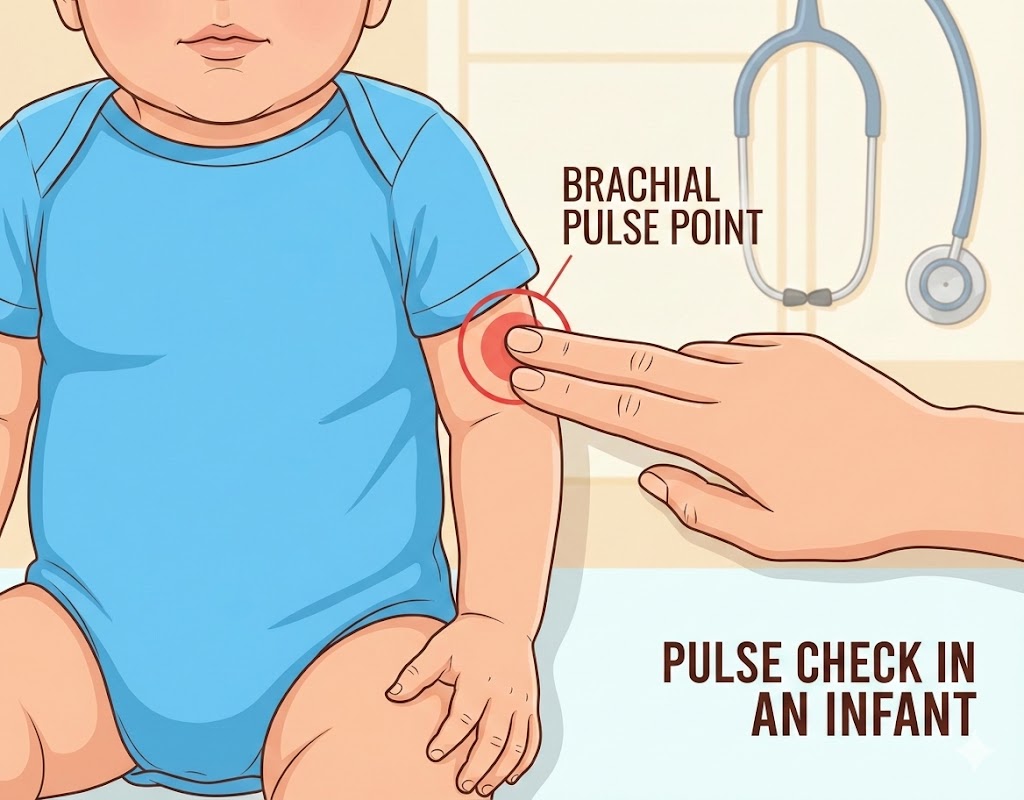
The brachial artery is the preferred pulse check location in infants because it is the most accessible, reliable, and safest site. Located on the inner part of the upper arm between the shoulder and elbow, the brachial artery offers a clear and consistent pulse point. Unlike the carotid artery, which is more difficult to locate in infants, the brachial site can be identified quickly even in high-stress scenarios. Additionally, using the brachial artery reduces the risk of compressing delicate structures in the neck or interfering with the airway, making it a safer choice for infants under one year old.
Step-by-Step Technique
To perform a proper brachial artery pulse check, the infant should be positioned flat on their back on a firm surface. Gently extend the infant’s arm out to the side or rest it alongside the body. Palpate the inner upper arm with your index and middle fingers, feeling between the biceps and triceps muscles. Avoid using your thumb, as it has its own pulse that can lead to mistaken readings. Apply gentle, controlled pressure to the area until you feel a pulse. Count for at least 5 to 10 seconds to determine the presence, rate, and quality of the heartbeat. This brief duration helps ensure accuracy without delaying care. When done correctly, the brachial pulse check provides a reliable indication of the infant’s circulatory status.
Common Mistakes to Avoid
Common mistakes can interfere with accurate pulse checks, so awareness is essential. One frequent error is applying too much pressure, which can obstruct the artery and make it impossible to feel the pulse. Another mistake is checking for too short a time, leading to premature assumptions about the infant’s condition. Incorrect finger placement can also confuse, especially in low-light or high-stress environments. Using the thumb is another error, as responders may mistakenly sense their own pulse instead of the infant’s. Avoiding these mistakes enhances reliability during life-threatening situations.
Alternative Pulse Check Locations (When to Use Them)
Although the brachial artery is the preferred site, there are times when alternative locations may be appropriate. The femoral artery, located in the groin area, can be used when the brachial pulse is difficult to locate, such as during trauma or when the infant’s arm is inaccessible. The femoral pulse point is strong and reliable, though it may require more practice to locate consistently. However, the carotid artery should not be used in infants under one year. It can be difficult to find due to the infant’s neck anatomy and poses a risk of airway obstruction if too much pressure is applied. The American Heart Association recommends avoiding the carotid pulse check in infants for these reasons.
What to Do After Checking the Pulse
Once the pulse check is complete, responders must take appropriate action based on the findings. If the infant has a pulse of 60 beats per minute or higher with signs of good perfusion, monitoring should continue while assessing breathing. If the infant is not breathing or only gasping, rescue breaths should be provided while activating the emergency response system as needed. When the pulse is absent or falls below 60 beats per minute with signs of poor perfusion, immediate CPR is required. A single rescuer should use a compression-to-ventilation ratio of 30 to 2, while two rescuers should follow a 15 to 2 ratio. Rapid initiation of CPR improves the chances of survival, especially when combined with prompt emergency activation.
Special Considerations for Healthcare Providers
Time Limits for Pulse Checks
Healthcare providers must also follow essential time limits when performing pulse checks. The maximum time allowed is 10 seconds, and this rule reflects the urgency of life-threatening conditions. Delays in recognizing a weak or absent pulse can postpone critical interventions such as CPR. Pulse checks should be integrated with other assessments, including checking for breathing and signs of circulation.
Integration with Other Assessment Skills
Providers should use the primary assessment approach to ensure a comprehensive evaluation. Staying current with AHA guidelines is key, and CPR St. Louis offers BLS for Healthcare Providers and PALS certification courses that include hands-on practice with real-world scenarios.
Practice Makes Perfect: Training Recommendations
Because accurate pulse checks require skill and confidence, hands-on training is essential for anyone responsible for infant care. Practicing on infant manikins builds muscle memory and prepares responders for real-life emergencies. Instructors can provide real-time feedback to correct technique and reinforce best practices. Healthcare providers must meet certification requirements for BLS and PALS, including regular recertification to stay current with evolving guidelines. Ongoing training ensures responders remain confident and prepared.
FAQs About Pulse Checks in Infants
- Why is the brachial artery preferred over the carotid artery for infant pulse checks?
The brachial artery, located on the inside of the upper arm, is preferred because infants have short, chubby necks that make the carotid artery difficult to locate. The brachial artery is more accessible and easier to palpate in infants under one year old. Additionally, checking the carotid artery in infants risks obstructing their airway due to their delicate anatomy.
- How long should you check for a pulse in an infant during an emergency?
You should check for a pulse for no more than 10 seconds. If you don’t feel a pulse within this timeframe, or if the heart rate is less than 60 beats per minute with signs of poor perfusion, begin CPR immediately. Time is critical in infant emergencies, and delays can be life-threatening.
- What should you do if you’re unsure whether you feel a pulse?
If you’re uncertain about detecting a pulse after 10 seconds, begin CPR immediately. It’s better to start chest compressions on an infant with a weak pulse than to delay life-saving intervention. Proper training helps build confidence in pulse assessment techniques.
Conclusion and Call to Action
Knowing the preferred method for checking an infant’s pulse can make the difference between life and death in an emergency. The brachial artery technique is a fundamental skill that every caregiver, parent, and healthcare provider should master through proper training.
Don’t wait until an emergency happens—get certified today. CPR St. Louis is an American Heart Association training site offering stress-free, hands-on PALS classes in St. Louis that teach you exactly how to assess and respond to infant emergencies. Whether you need initial CPR certification in St. Louis or renewal courses in BLS for Healthcare Providers, ACLS, or CPR and First Aid, our expert instructors provide the practical skills and confidence you need to save lives.
Contact CPR St. Louis today to schedule your PALS or CPR certification class and be prepared when it matters most.